Past Due Invoice Template (Free Download)
The template is the easy part. The fields most contractors leave blank or fill in wrong — the late fee clause, the payment terms reference, the follow-up sequence — are what determine whether the invoice actually gets paid.
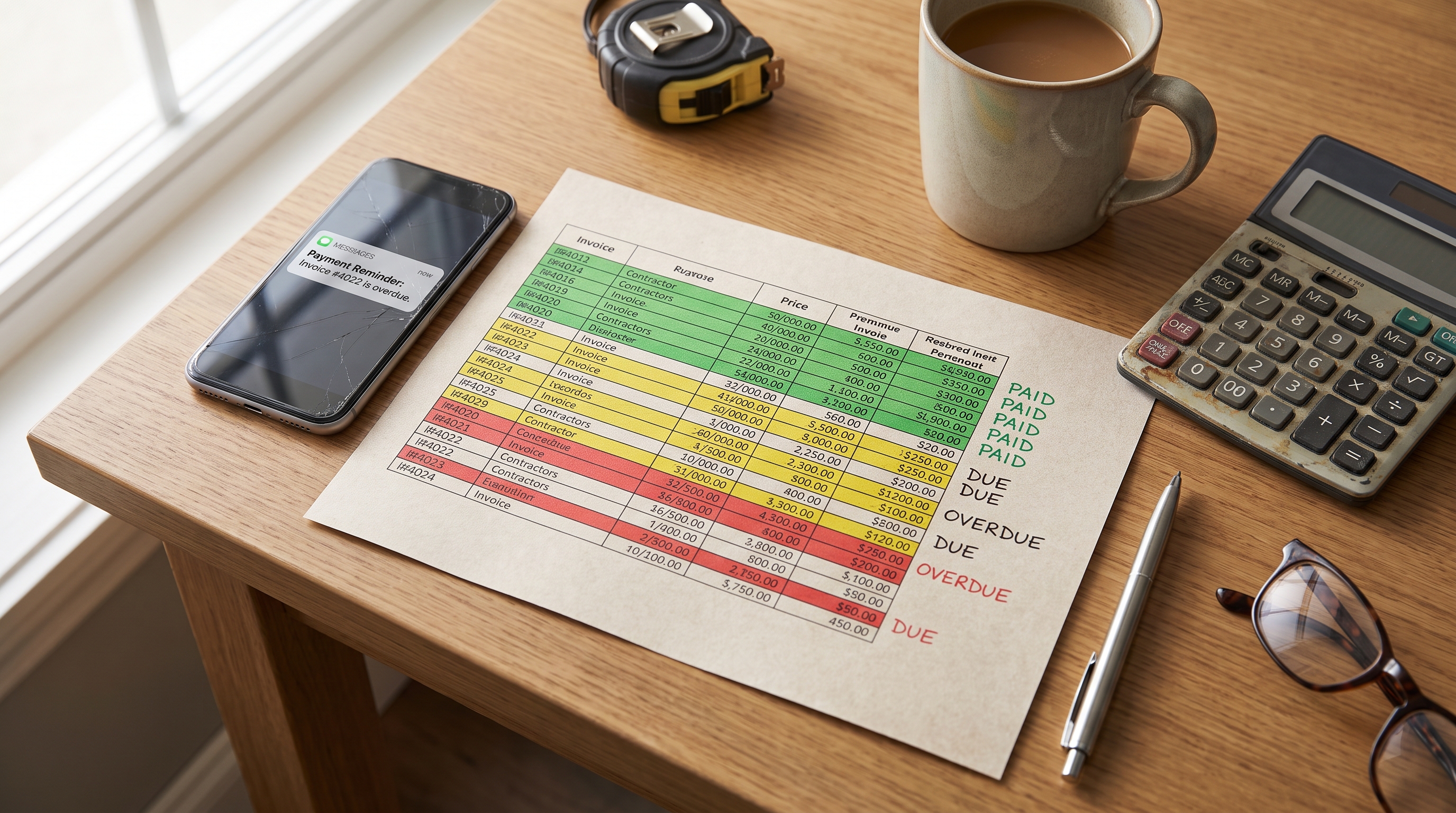
The template is the easy part. You can find a past due invoice template in thirty seconds. Fill in your name, the client's name, the line items, the total. Done.
But a template without the right language on it is a formatted way to get ignored. The fields most contractors leave blank or fill in wrong are the ones that determine whether the invoice actually gets paid: the late fee clause, the payment terms reference, and the follow-up sequence that runs after you send it. A past due invoice is not a collections problem. It is a setup problem that started before the original invoice went out.
The short answer
A past due invoice template needs the original payment terms, a late fee clause referencing the signed contract, and the specific days-past-due count. Three of the top five causes of late payment are entirely preventable — ambiguous terms, invoice errors, and no automated follow-up. Fix those upstream and you use the past due template less often.
What a past due invoice template needs
Most templates online cover the basics. A past due invoice template should have sections for both the sender's and buyer's information, including names, companies, addresses, and contact details. The invoice details section should include the invoice number, date, and payment terms. It should list the products or services provided, along with their descriptions, quantities, unit prices, and total prices. It should also include a subtotal, any applicable discounts, tax calculations, and the total amount due, plus spaces for an authorized signature.
That covers the standard fields. For contractors, three additions separate a template that collects from one that collects dust:
A late fee statement. Not buried in a contract appendix. On the invoice itself, referencing the terms the client already signed. More on the exact wording below.
The original payment terms. If your contract says Net 30, restate it on the past due notice. The client needs to see the deadline they missed, not just the new total.
A "past due" notice with a specific date. "Past due" means the due date has passed without payment. "Overdue" indicates a more critical situation where payment is significantly late, typically 30 or more days past the due date. Your template should state which category this invoice falls into and when the original payment was due.
Here is the template:
[Your Business Name]
[Your Address] | [Phone] | [Email]
PAST DUE INVOICE
| Field | Details |
|---|---|
| Invoice Number | [INV-XXXX] |
| Original Invoice Date | [MM/DD/YYYY] |
| Due Date | [MM/DD/YYYY] |
| Days Past Due | [X days] |
Bill To:
[Client Name]
[Client Address]
[Client Email]
| Description | Qty | Unit Price | Total |
|---|---|---|---|
| [Service/materials description] | [X] | $[X.XX] | $[X.XX] |
| [Service/materials description] | [X] | $[X.XX] | $[X.XX] |
| Subtotal | $[X.XX] |
| Tax | $[X.XX] |
| Late Fee ([X]% per month, per signed agreement dated [MM/DD/YYYY]) | $[X.XX] |
| Total Amount Due | $[X.XX] |
Payment Terms: Payment was due [Net 30/upon receipt] per our signed agreement. This invoice is now [X] days past due.
Late Fee Notice: Payment is due within 30 days. Please be aware that we will charge [1.5]% interest per month on late invoices, as agreed in our signed contract dated [MM/DD/YYYY].
Accepted Payment Methods: [Bank transfer / Credit card / ACH / Check]
Authorized Signature: _________________ Date: _________
Reference the invoice number in every follow-up email and reminder you send. This is basic but ensures clarity for clients who may have multiple open invoices with you.
Why contractors get burned more than other businesses
A retailer collects payment at the register. A SaaS company charges the card before the software unlocks. Contractors do neither.
Field-service companies face unique challenges: projects span weeks, so you often float material and labor costs upfront. Work is typically off-site, complicating point-of-sale collections. Home-service customers may ignore mailed statements, forcing repeated outreach.
The scale of the problem nationally is significant. 56% of US small businesses are owed money from unpaid invoices, averaging $17,500 per business. Nearly 47% reported a portion of their invoices were overdue by more than 30 days. And 54% of small business owners have sacrificed their own paychecks to cover business expenses because of it.
US small business invoices are paid eight days late on average. Eight days may sound manageable until you are waiting on a $12,000 materials reimbursement while your supplier's terms are Net 15.
This is why the template matters more for contractors than for most other businesses. You are not writing off a $50 subscription fee. You are carrying thousands in labor and materials with no guarantee of collection.
The late fee clause: what to write and where
A late payment fee is only enforceable when the client agreed to it in advance, and the terms were in writing. You cannot add a late fee after the fact. The moment a client misses a due date, you become a de facto creditor, and as with any credit transaction, you must spell out the terms in advance and in writing to legally impose the charge.
Your invoice needs four late-fee elements: the date of the invoice, the balance owed, the payment terms (e.g., Net 30 days), and a statement of the late fee that will apply.
How much to charge. The standard range is 1% to 1.5% of the invoice amount per month. At 1.5% monthly, that works out to 18% annually. For smaller invoices, flat fees typically run $25 to $50 per overdue invoice.
State limits. More than 30 US states have no statutory maximum late fee for B2B invoices, but state usury laws still apply. Check your state before setting a rate.
Where to put it. Two places, minimum:
- In your original contract or estimate, before work starts. This is the enforceable agreement.
- On every invoice, restating the terms. Keep it simple: "Payment is due within 30 days. Please be aware that we will charge 1.5% interest per month on late invoices."
The contract creates the legal foundation. The invoice restates it so the client cannot claim they forgot. If you need help structuring the original agreement, our late payment fee guide walks through every state consideration, and our late payment policy template gives you the contract language.
Why invoices go past due (and which causes you can prevent)
Five causes account for most late payments in contractor and field service work:
| Cause | Preventable? | Prevention |
|---|---|---|
| Ambiguous payment terms | Yes | State Net 30 (or your terms) in the contract, estimate, and invoice. Do not bury it. |
| Invoice errors | Yes | Match PO numbers, verify line items against the scope of work, attach job photos if applicable. |
| No automated follow-up | Yes | Set reminders before the invoice goes out, not after you realize it is late. |
| Seasonal cash crunches | Partially | Require a 30 to 50% deposit upfront on materials-heavy jobs to reduce the total balance at risk. |
| Post-work disputes | Partially | Document scope changes with signed change orders and photograph completed work. |
Three of the five are entirely within your control. The template handles ambiguous terms. A clean invoicing process handles errors. Automated reminders handle follow-up. The other two require upfront project management, but deposits and change orders reduce your exposure.
The follow-up sequence: what to send and when
A past due invoice template is one document. Collecting on it requires a sequence. The five-step escalation that works for contractors:
Day 1 past due: written reminder (email and SMS). Tone is friendly. The client may have simply forgotten. Reference the invoice number, the amount, and the original due date. A reminder within a week of the payment due date is standard.
Day 15: phone call. If the written reminder got no response, pick up the phone. Late-paying customers generally fall into three categories: those who want to pay but have real financial problems, those who prefer to delay or juggle payments, and those who will do whatever possible to avoid paying. Your tone on this call depends on which category you are dealing with.
Day 30: apply late fees and send a firmer written notice. The late fee clause you included in the contract and restated on the invoice now activates. Send an updated invoice showing the late fee applied.
Day 60: formal demand letter via certified mail. This is different from a reminder. A demand letter is a formal document that creates a legal record. It should include the total amount owed, your contact information, where the client should send payment, and a deadline for payment. Certified mail provides proof the client received it.
Day 90 and beyond: collections agency or small claims court. At this point, the relationship is secondary to recovering the money you are owed.
What happens when you do not follow up
Skipping the sequence has costs beyond the single unpaid invoice. Not handling late payments leads to cash flow disruptions that make it hard to meet your own obligations (suppliers, employees, overhead), strained client relationships from inconsistent chasing, additional costs if you eventually pursue legal collections, and missed growth opportunities because limited cash flow prevents you from taking on new projects.
The compounding effect is the real damage. One unpaid $8,000 invoice means you cannot buy materials for the next $15,000 job. That job goes to another contractor. The revenue loss is not $8,000. It is $23,000.
Meanwhile, small-business owners lose 10% of every workday chasing unpaid invoices instead of booking profitable jobs. That is roughly four hours a week spent on the phone, writing emails, and checking bank accounts instead of bidding or building.
Automating the reminder sequence
The template and the follow-up sequence work together. But running a five-step escalation manually, while you are on a roof or under a house, is where the system breaks down. "No automated follow-up" is one of the top reasons invoices go past due in the first place.
Nudge connects to your invoicing workflow and runs enabled due-date-based reminder stages automatically. Choose which of the up to 9 stages are enabled and whether the invoice uses email, SMS, or both, then let the sequence run without you checking your phone between jobs. For a full breakdown of how automated reminders work, see invoice payment reminders for contractors.
The template gives you the right document. The late fee clause gives you legal standing. The automated sequence makes sure neither one sits unused in your sent folder.
Two things worth doing before your next invoice goes out: add the late fee language to your contract (our late payment fee guide covers exact wording), and set up reminders so you are not the one tracking due dates. If you want the full picture on collecting, our guide on how to collect payment from clients covers everything beyond the invoice itself. And if you are still drafting the original invoice, how to write an invoice covers every field from scratch.
Offering multiple payment methods raises on-time payment odds by up to 30%. Add ACH, credit card, and bank transfer options to every invoice. The easier you make it to pay, the less often you will need the past due template at all.
READ MORE