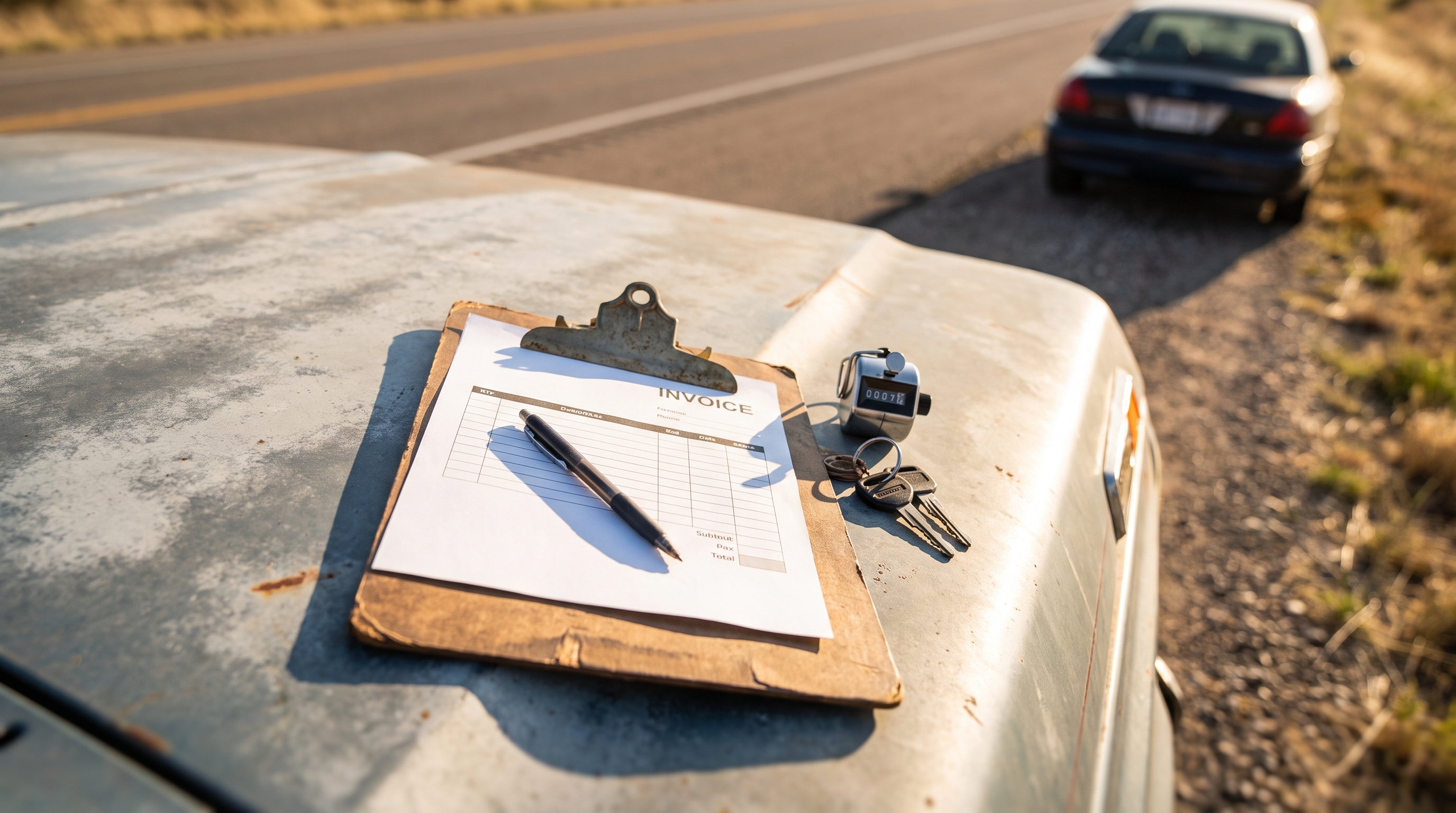
Towing disputes rarely start with the dollar amount. They start with a missing timestamp, an unsigned authorization, or a mileage number nobody can verify. The invoice that settles a roadside call cleanly and the one that triggers a three-week back-and-forth with an insurance adjuster often differ by a few fields.
A vehicle towing receipt describes the vehicle, the reason for towing, and the summary of charges. That definition sounds simple. In practice, a towing invoice template needs to function as a chain-of-custody document: proving who authorized the tow, what truck and driver handled it, where the vehicle went, and how every dollar on the bill connects to a recorded event. Get the dispatch and mileage fields right, and the rest of the invoice fills itself in.
What a towing invoice actually needs to do
A standard contractor invoice tracks work performed and money owed. A towing invoice does that, plus it documents custody of someone else's property.
Vehicle details on every towing invoice should include year, make, model, color, VIN, and plate. That level of identification is not optional paperwork. Missing vehicle identifiers makes it hard to prove chain of custody, and without chain of custody, you cannot defend a storage charge, an impound release, or a damage claim.
Authorization name, signature, and role as well as incident or case number should appear on the invoice. A police rotation call, a motor club dispatch, and a private owner calling from the side of the road each involve different authorization paths. The invoice needs to record which one applied to this specific job.
If you run a shop that also handles mechanical work, an auto repair invoice template covers parts and labor for the repair side. Keep the tow and the repair on separate invoices so each one stands on its own as documentation.
The dispatch fields every towing invoice should capture
Dispatch happens before the truck rolls. The invoice should reflect that sequence. These fields establish who handled the call, who authorized it, and what the operator confirmed before leaving the yard.
Driver and truck identification. Driver name and truck ID or plate are mandatory. If your jurisdiction requires it, add your tow license number and DOT/MC number. Insurance companies and motor clubs routinely reject invoices missing these.
Call details and payer. The invoicing process starts with confirming the call details, destination, payer, and expected arrival. "Payer" is a field most generic templates skip entirely. On a motor club call, the payer is the club. On an insurance tow, the payer is the adjuster's office. On a private call, the payer is the vehicle owner. Recording this at dispatch prevents billing the wrong party.
Authorization. Secure written or recorded authorization and collect a deposit for long-distance or specialty recovery if needed. Verbal authorization works in the moment, but it does not hold up when an owner disputes the charge two weeks later. A signature field, a recorded phone consent note, or a dispatch system confirmation number all serve as verifiable records.
These dispatch fields precede mileage on the form because they precede mileage on the job. You confirm authorization before you drive to the scene.
How to structure mileage on a towing invoice
Mileage is where most towing invoice templates fall short. A single "mileage" line with a total does not give the payer enough information to verify the charge.
Hookup fee first. The base hook fee covers hookup and safety checks before the truck rolls and is billed as a single dispatch item. This is a flat charge, separate from distance. It covers the work of securing the vehicle to the tow rig: chains, straps, light connections, safety checks.
Per-mile rate after included miles. Towing companies typically charge a hookup fee first, then a set price per mile, with many including the first few miles in the base fee. Your template should state how many miles the base fee includes. If your hookup fee covers the first five miles and the tow ran twelve miles, the invoice should show seven billable miles at your per-mile rate.
Odometer or GPS backup. Mileage towed should be billed as miles times per-mile rate with odometer or GPS as backup documentation. Add fields for odometer at pickup and odometer at drop-off. The difference is the mileage. GPS logs from your dispatch system serve the same purpose and are harder to dispute.
Break mileage into these three components (hookup fee, included miles, excess miles with rate) and the payer can verify every dollar without calling your office.
Line items beyond mileage: the full billing picture
Mileage and the hookup fee account for a basic tow. Most jobs involve at least one additional charge. Here are the standard line items, when they apply, and how to bill them:
| Line Item | When It Applies | How to Bill | Documentation |
|---|---|---|---|
| Winching/recovery | Stuck, off-road, or overturned vehicle | Time times hourly rate | Recovery photos, rated gear used |
| Dollies/wheel-lift add-on | AWD, locked wheels, or tight access | Quantity times add-on rate | Prevents drivetrain damage and claims |
| Flatbed upgrade | Low clearance, luxury, or damaged vehicle | Single upgrade rate | Required by many OEMs for safe transport |
| After-hours/holiday surcharge | Nights, weekends, or holidays | Single surcharge | Covers crew availability outside standard hours |
| Storage (per day) | Vehicle held in your yard | Days times daily rate | Note in/out times and release paperwork |
| Service call fee | Roadside service labor | Flat fee | Separates arrival cost from on-site work like a jump or lockout |
The service call fee is worth understanding on its own. It separates arrival cost from on-site work like a jump-start or lockout. Combining them into one charge obscures what the customer is paying for. Two lines, one for showing up and one for the service performed, read as transparent. One merged line reads as inflated.
Recording the job as you go
The cleanest towing invoice template is useless if you fill it in from memory back at the shop. The data that makes an invoice defensible comes from the field.
During the job, record timestamps, odometer, mileage, equipment used, and any wait time. A practical capture sequence:
- At dispatch: Log the call time, caller name, authorization, and destination.
- At pickup: Note the arrival time, odometer reading, vehicle condition, and any photos of pre-existing damage.
- During the tow: Record equipment deployed (dollies, flatbed, winch) and any wait time at the scene.
- At drop-off: Log the arrival time, odometer reading, and who received the vehicle (or the storage lot entry time if no one is receiving it).
Pickup and drop-off location and time as well as odometer readings and total mileage should transfer directly from your field notes to the invoice. If you use a dispatch app, most of this populates automatically.
Common invoicing mistakes that stall payment
Three errors cause the majority of towing invoice disputes:
No timestamps on pickup and drop-off. Leaving out pickup and drop-off details causes delays and disputes about where and when the vehicle moved. Capture complete addresses with timestamps for both ends and add them to the header. Use your dispatch log to confirm times. An invoice that says "towed vehicle from Main St to ABC Storage" without times is an invoice a claims adjuster will put at the bottom of the pile.
Missing vehicle identifiers. VIN, plate, year, make, model, color. Skip any of these and you weaken the chain of custody. If two silver Honda Accords sit in your lot and the invoice just says "silver Honda," you have a documentation problem.
No authorization record. The person who called is not always the person who pays. If the invoice does not record who authorized the tow, and the payer did not authorize it, the invoice is going to be contested. Attach the authorization (signature, dispatch confirmation, case number) to the invoice itself.
All three of these gaps can be filled from a complete dispatch log. If your dispatch records are solid, your invoices will be too.
Template formats and when to use each
Towing invoice templates are available in PDF, Word, Excel, Google Docs, or Google Sheets. Which format works best depends on where you do your billing.
PDF works for operators who fill invoices on-site from a tablet or phone. The layout stays fixed, fields are tappable, and the finished document looks professional when emailed to a motor club or insurance company. Downside: you cannot add rows for unusual jobs without editing the source file.
Word or Google Docs give you the most formatting control. Add your logo, adjust field labels, insert a terms-and-conditions block at the bottom. Good for operators who bill from the office after the job.
Excel or Google Sheets are the best choice if you want automatic totals. Set formulas for mileage (excess miles times rate), storage (days times daily rate), and tax. Google Sheets has the added advantage of being accessible from any device, which helps if your driver starts the invoice on a phone and your office manager finishes it on a desktop.
Once you have the invoice sent, the next challenge is making sure it gets paid on time. Setting up invoice payment reminders keeps towing invoices from aging past 30 days, especially on insurance and motor club claims where payment cycles are longer than direct-pay jobs.