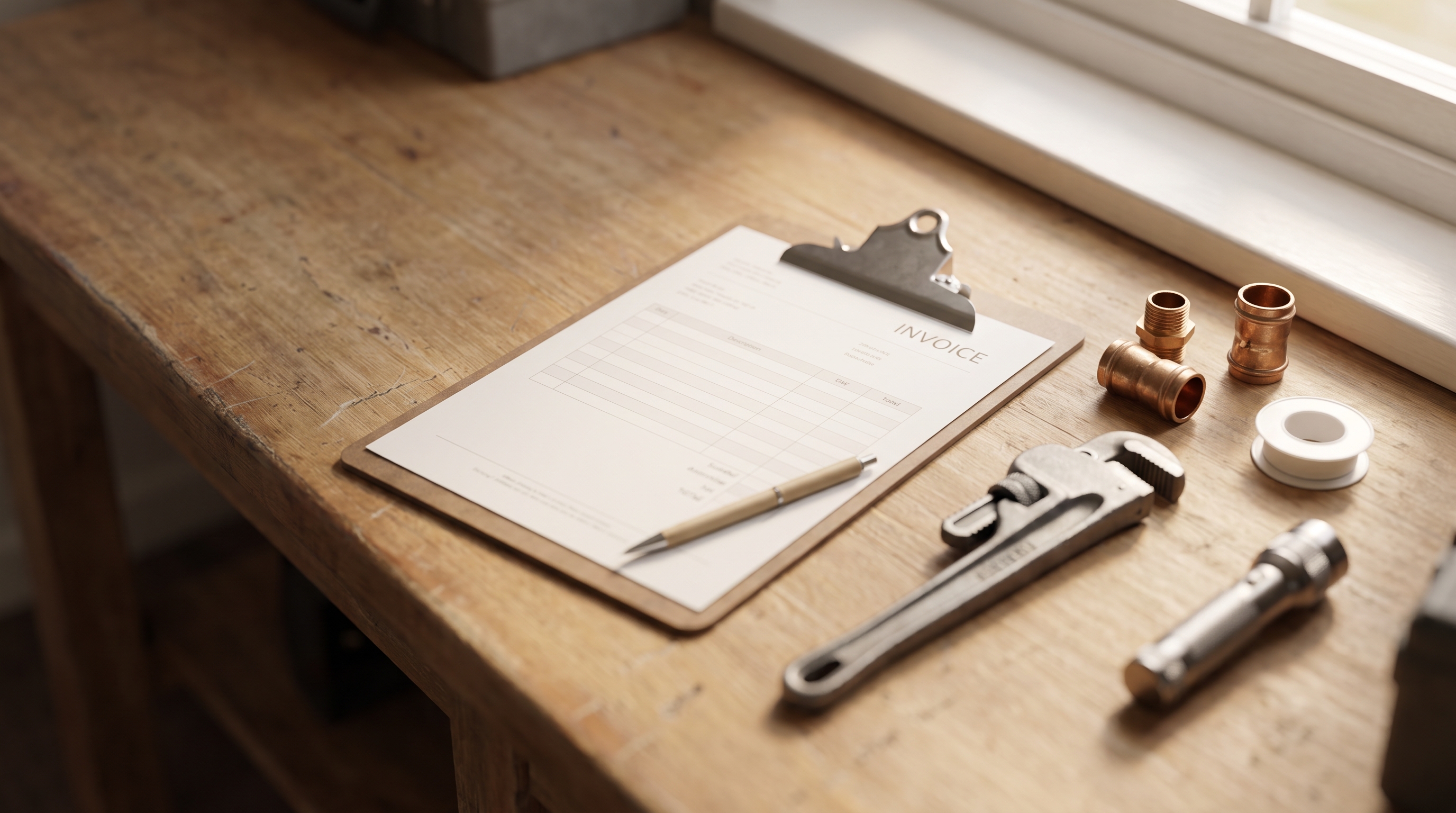
Most plumbing invoice templates give you a blank table and leave you to figure out what goes in it. The result is predictable: labor and materials get bundled into one line, the client sees a number with no context, and the phone call starts with "Can you break this down for me?"
That call is a payment delay dressed up as a question. Bundling parts and labor into one number hides value and sparks price disputes. Separate lines with quantities and units show clients exactly what they paid for.
The plumbing invoice template below is built around a different structure. Every labor task gets its own line: hours worked, hourly rate, total. Trip charges, emergency surcharges, and materials each sit on their own rows. The result is an invoice that works as evidence of what was done, not just a request for money.
Why bundled invoices cause payment problems
The plumbing industry has been shifting toward flat, project-based pricing for most residential and small commercial work. A water heater replacement might be calculated internally as 3 hours at $110/hour plus parts, then presented to the customer as a $1,200 flat fee.
But behind every flat price is an hours-times-rate calculation. When scope changes mid-job, when an emergency call runs longer than expected, when a client adds "one more thing" while you're already under the house, that internal math needs to become the external record. A template that treats labor as a single lump sum gives you no structure to capture those changes.
Hourly billing still applies to work where scope is uncertain, like leak detection, complex troubleshooting, major repipes, or commercial renovations. For these jobs, your invoice needs to show exactly how the hours added up.
Required fields on every plumbing invoice
Before getting into labor structure, the baseline. Missing any of these fields either delays payment or raises compliance questions.
Business information. Your business name, logo, phone number, email, and street address. Add your license number on every invoice, not just when clients ask.
Client details. Customer's name and contact information. For commercial jobs, include the company name and the name of whoever authorized the work.
Invoice identifiers. A unique invoice number for record-keeping (sequential is fine: #1001, #1002), the issue date, and the payment due date.
Permit and inspection numbers. Leaving off permit or inspection numbers makes the job look non-compliant and delays payment. Include them when applicable. If a permit wasn't required, write "N/A" so reviewers don't have to guess.
For a deeper walkthrough of general invoice structure, see our guide on how to write an invoice.
How to structure labor as trackable line items
This is what separates a useful plumbing invoice template from a generic one. Each task type becomes its own row with hours, rate, and total. Here is how common plumbing work maps to line items:
| Line Item | Type | What It Covers | Billing Structure |
|---|---|---|---|
| Trip/diagnostic fee | Item | First visit, travel, initial assessment | Qty × call-out rate |
| Leak repair labor | Time | Active repair, noting location and parts replaced | Hours × hourly rate |
| Fixture install labor | Time | Toilet, faucet, or sink installation | Hours × hourly rate |
| Drain cleaning | Time | Clearing and camera inspection | Hours × hourly rate |
| Water heater replacement labor | Time | Removal, install, connection | Hours × hourly rate |
| After-hours/emergency surcharge | Item | Work outside standard business hours | Qty × surcharge rate |
| Materials | Item | Parts, fittings, fixtures with markup | Qty × unit price |
| Haul-away fee | Item | Disposal of old unit | Flat fee |
| Permit processing | Item | Filing and permit fees | Flat fee |
Source: InvoiceQuick plumber invoice template
The key detail: each line item needs a description of services, quantity of materials and hours, price of the service, and total cost. "Plumbing work: $1,400" fails this test. "Leak repair labor: 2.5 hrs × $95/hr = $237.50" passes it.
If you also do construction or remodeling work, our construction invoice template follows the same itemized approach for larger-scope projects.
2025 rate benchmarks for your labor fields
Knowing what to charge matters as much as knowing how to bill it. These are the ranges your hourly rate fields should reflect.
By experience level:
- Apprentice: $45–$90/hour
- Journeyman: $60–$110/hour
- Master plumber: $90–$200/hour
Master plumbers command the highest rates because they can handle complex installations, pull permits, supervise work, and ensure code compliance on commercial projects.
By job type:
The two rarely cross over. Commercial contractors deal with different building codes, equipment, and skill sets than residential plumbers.
By region: Rates run 20–30% higher on the Northeast and West Coast compared to the Midwest and South. A journeyman billing $85/hour in Ohio might bill $105–$110/hour for the same work in New Jersey.
The overhead multiplier. If you're setting rates for the first time, know that the billable rate is typically 2.5 to 3 times the plumber's base wage. An employee earning $28/hour costs you $70–$84/hour to deploy once you factor in trucks, tools, licensing, insurance, benefits, and admin staff. For national wage benchmarks and job outlook projections, see the BLS plumber outlook.
After-hours and emergency calls: billing the surcharge correctly
Emergency and after-hours jobs are the most commonly under-billed work on a plumbing invoice. The surcharge exists for a reason, but it gets lost when folded into a general "labor" line.
Emergency calls outside regular hours cost an extra $100 to $300 or more on top of standard rates. Trip fees range from $50 to $300. In rural markets, travel fees are especially common, often adding $50 to $100 per trip for work outside your primary service area.
The surcharge must appear as its own line item on the invoice. Show the time window it covers (e.g., "After-hours surcharge, 11:15 PM–1:30 AM Saturday") rather than folding it into the hourly labor total. An emergency service call and the after-hours fee are distinct billing items that show the client exactly why the total is higher than a standard weekday visit.
How to fill out the template step by step
A plumbing invoice template only works if you follow the same sequence every time. Here is the workflow that prevents missed charges.
1. Confirm scope and collect a deposit. Before starting, document what was agreed. If you're collecting a deposit, record the amount and method. You will subtract this from the final invoice.
2. Track hours and parts on the job. Note start and stop times for each task. Record every part used with quantity and unit cost. Do this on-site, not from memory at the end of the day.
3. Create the invoice within 48 hours. Sending invoices late leads to confusion and delays payment. The closer the invoice is to the completed work, the fewer questions the client has.
4. Itemize labor by task, materials separately. Each task type gets its own line showing hours and rate. Materials go in a separate section with quantities and unit prices. Never combine them.
5. Apply the deposit and show the balance due. If a deposit was collected, show the invoice subtotal, then the deposit as a credit, then the remaining balance. The client should be able to trace every dollar.
6. Add payment terms with a late fee percentage. Specify the number of days within which payment must be made and a percentage that will be added if payment is late. If you use net-30 terms, state that explicitly. Our guide on late payment fees covers how to set these without straining client relationships.
7. Send and follow up. Email or deliver the invoice promptly. Plumbing invoices are typically due within 30 days, with two weeks as common practice. If you want a system for following up automatically, invoice reminder software handles the sequence so you don't have to send each message manually.
Three invoicing mistakes that slow payment
Bundling labor and materials into one line. This is the single biggest source of client pushback. Split materials and labor on separate lines with quantities and units so the client sees what each dollar covers. A client who understands the invoice pays the invoice.
Missing permit or inspection numbers. On permitted work, leaving these off makes the job look non-compliant. Property managers and commercial clients will hold payment until they can verify compliance. Add the numbers every time.
Not recording the deposit on the invoice. If you collected a deposit at the start of the job, it needs to appear on the final invoice as a line-item credit. Otherwise, the client sees a total that doesn't match what they expected to owe, and that mismatch becomes a phone call.
After the invoice: making sure you get paid
The template captures the work. The follow-up system captures the money.
Send the invoice within 48 hours of completing the job. Set a payment deadline within 30 days. Include your late fee terms on the invoice itself, because if the original invoice didn't mention them, you typically cannot enforce them later.
When invoices go past due, having a defined follow-up sequence matters more than the wording of any single reminder. Our guides on invoice payment reminders and how to collect payment from clients cover what to say and when to say it, from the first gentle nudge through to final escalation steps.